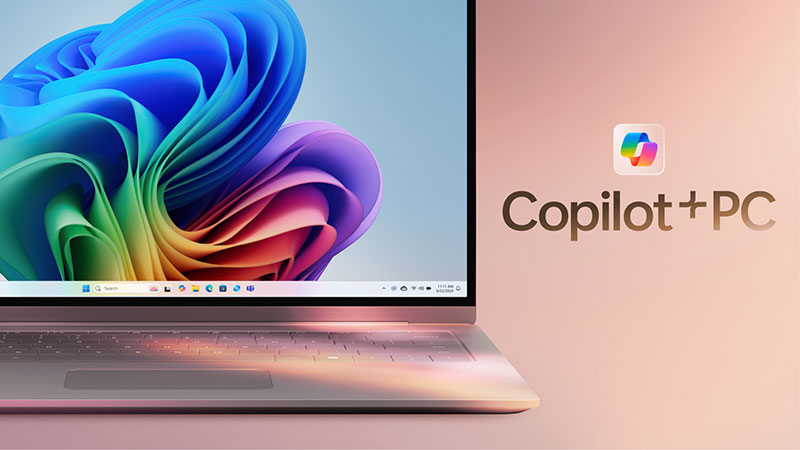
In the ever-evolving world of technology, the personal computer (PC) has undergone a remarkable transformation, and the introduction of Copilot+ PC marks a significant milestone in the industry. This cutting-edge technology promises to revolutionize the way we interact with our devices, offering unparalleled performance, versatility, and user-friendly features.
The Rise of Copilot+ PC
Copilot+ PC is a groundbreaking concept that combines the power of artificial intelligence (AI) with the convenience of a traditional PC. By integrating advanced AI algorithms into the core of the system, Copilot+ PC offers users a seamless and intuitive experience, making it easier than ever to accomplish tasks and access information.
Al inside a PC
AI PCs are essentially personal computers that incorporate specialised processors or accelerators called Neural Processing Units or NPUs, which are optimised to run Al apps locally on the device rather than relying on cloud- based services such as a ChatGPT or a Gemini. The rush for Al supremacy and AI products has sharply increased over last 24 months. More importantly after Covid, there has been an increased demand for new hardware and the accompanying software. The latest version of Windows will have a dedicated Copilot key and an NPU capable of over 40 trillion operations per second. Consumers will be able to run Microsoft Copilot locally on their personal machine such as a laptop or a desktop. Unlike traditional GPUs (graphic processing units such as the ones made by Nvidia) or traditional CPUs (central processing units), a NPU is almost entirely optimised for Al computation at the hardware level to improve performance and energy efficiency.
The Tech behind on device Machine Learning
The development comes at a time when there is talk of a slow pivot in machine learning (ML) and Al models from ‘training, or the first phase for an Al model, to what is called ‘inference’. Training entails a process of trial and error or a process of acquainting the Al model with examples of the desired inputs and outputs or both. That is what foundational models such as OpenAl’s Chat GPT, Google’s Gemini and Meta’s Llama, have done. Inference is the process that follows Al training, where a trained model is then fine-tuned for practical, and sometimes more specific, use and new applications are built on it.
Traditionally, training models only ran on powerful servers in the cloud, or a network of data centres, given the huge volume of data that needs to be processed for simply training the algorithm. For this cloud infrastructure of servers is necessary on a larger scale. These cloud infrastructures are usually managed by third party providers, which requires a dedicated IT team, a need to purchase, install and manage these with constant upgradations on site.
But in contrast to this is the ‘On-premises software infrastructure.’ On-premises software is installed and runs on computers on the premises of the person or organization using the software, rather than at a remote facility such as a server farm or cloud. On-premise (or on prem) infrastructure is more like a private cloud environment that is available for use only by one client.
On-device ML is when the consumer performs inference with models directly on a device using a mobile app or web browser. Al processing that happens right on a user’s computer, which is also sometimes called edge computing.
With edge computing, the ML model processes input data-like images, text, or audio-on a device, rather than sending that data to an external server. That really is the new frontier, which hard- ware and software makers in the personal computing space are pushing. Big improvements in compute power (CPU, GPU processing power, and through dedicated ML accelerator blocks such as NPUs) have enabled bringing on-device performance close to what could be achieved on dedicated servers.
The advantages include lower latency, since there is no round trip to the server and back, along with greater privacy as the data processing is happening on the user’s device itself. This is making Copilot+ PC significantly different from its counterparts.
Key Features of Copilot+ PC
The Future of Personal Computing
As technology continues to advance, the Copilot+ PC represents a significant step forward in the evolution of personal computing. By combining the power of AI with the convenience of a traditional PC, this innovative technology offers users a glimpse into the future of how we interact with our devices.
With its cutting-edge features and user-friendly interface, Copilot+ PC is poised to become the new standard in personal computing. As more and more people embrace the benefits of AI-powered technology, it’s clear that the Copilot+ PC is the next wave of personal computers, offering a glimpse into a future where technology and human interaction are seamlessly integrated.
Reference: