National Security in India is a complex undertaking and requires varied solutions to address multi-modal directives.
The rapid evolution of Artificial Intelligence (AI) has transformed the landscape of national security, offering a plethora of opportunities to enhance the protection of a country’s borders, citizens, and interests. As India grapples with the challenges of modern warfare, terrorism, and cyber threats, the strategic integration of AI into its national security framework has become a pressing imperative. This article delves into the ways AI can bolster national security, highlighting relevant examples and case studies from India’s ongoing efforts to leverage AI for a safer tomorrow.
Surveillance and Border Security
AI-powered heterogeneous robotic systems can significantly enhance India’s surveillance capabilities, particularly along its extensive land and river borders. The use of Autonomous Land Vehicles (ALVs), Unmanned Aerial Vehicles (UAVs), and integrated systems can provide real-time data sharing, enabling swift and effective responses to potential security breaches. This technology has the potential to revolutionize border security, allowing for more efficient monitoring and response to emerging threats.
For example, in 2018, India’s Border Security Force deployed an AI-based surveillance system called “Drishti” along the Bangladesh border. Drishti uses surveillance cameras and AI algorithms to detect and track any suspicious activities along the border. The system can alert security personnel in real-time, allowing them to intercept and prevent illegal cross-border activities and smuggling of goods or cattle.
AI in the Indian Armed Forces
The Indian armed forces are undergoing a significant transformation, with the establishment of five theatre commands aimed at enhancing synergy and effectiveness. AI can play a crucial role in this transition by streamlining logistic management, facilitating swift and coordinated responses to emerging threats.
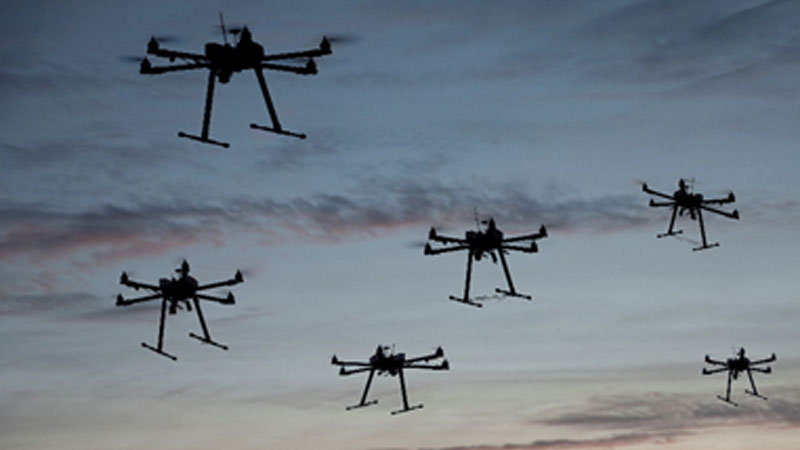
Example: Drone Swarms of the Indian Army, equipped with AI Capabilities:
Drone Swarms are a group of drones operating in conjunction with ground manoeuvre forces. This provides an aerial manoeuvre capability during offensive as well as defensive tasks. Swarm Drones can be effectively employed to detect enemy ground activities and target enemy ground forces to include troops, vehicles and command and control links. Artificial Intelligence and machine learning algorithms used in the system are capable of communicating with each other to form a swarm and achieve a collective goal. Artificial Intelligence algorithms have also been designed and developed to compute the shortest path, form a pattern, and achieve a common goal such as the combined search of a large area, also known as combing operation. Each drone is powered with distributed active collision avoidance algorithms. These algorithms compute any future collision with every other drone and alter its path dynamically.
Cybersecurity and Data Protection
AI-driven tools are being increasingly adopted by both government entities and private companies in India to enhance cybersecurity and data protection. The National Cyber Security Strategy aims to strengthen the country’s cybersecurity infrastructure, with AI and machine learning being used to develop advanced threat detection and prevention systems. Public-private partnerships are also being fostered to share threat intelligence and stay ahead of potential attacks.
For example, the Indian Government launched the Cyber Swachhta Kendra, an AI-based cybersecurity solution, which provides real-time alerts and recommendations to prevent cyber-attacks. The system can detect and block suspicious emails and websites, protecting government systems and networks from cyber-attacks.
Counterterrorism:
AI-based solutions can also be used to prevent and counter terrorist activities. AI algorithms can identify potential terrorist threats by analysing social media data and online activities. For example, in 2017, the Indian Government launched the “National Intelligence Grid” (NATGRID), which uses AI-based tools to analyse data from various sources like immigration, banking, and telecom. The system can identify potential terrorist activities and provide real-time alerts to security agencies, allowing them to take corrective action quickly.
Challenges and Concerns
While AI offers immense potential for national security, its adoption is not without challenges. The need for transparency in AI applications, concerns around data access and protection, and the risk of AI being used for malicious purposes are all critical issues that must be addressed. Furthermore, the ethical and regulatory implications of AI in national security cannot be overstated, with the need for a multi-disciplinary approach to policy-making and regulation.
India’s AI Implementation Roadmap
The Ministry of Defence’s Department of Defence Production established a task force in February 2018 to examine the prospective implementation of AI in defence contexts. Its report was submitted in June 2018 under the “Strategic Implementation of AI for National Security and Defence” task force. In 2019, a Defence AI Project Agency (DAIPA) and a Defence AI Council (DAIC) were established by the task force’s recommendations. In addition to it, the Ministry of Electronics and Information Technology has constituted committees to encourage research in AI, while a task force has submitted recommendations on the strategic and national security implications of AI for India.
Conclusion
AI has the potential to be a game-changer in the realm of national security, offering enhanced surveillance, cybersecurity, and logistics management capabilities. As India continues to navigate the complexities of modern warfare and terrorism, the strategic integration of AI into its national security framework is crucial. However, this must be accompanied by a nuanced understanding of the challenges and concerns associated with AI, as well as a commitment to ethical and regulatory frameworks that ensure its responsible use. By exploring the opportunities and challenges of AI in national security, India can stay ahead of emerging threats and protect its citizens and interests in an increasingly complex world.